If you’ve been comparing exfoliating acids and feeling confused about which one your skin actually needs, you’re not alone. Understanding aha bha pha differences is essential for choosing products that truly match your skin type, concerns, and sensitivity level. With so much conflicting advice online, it’s easy to misuse these ingredients and end up with irritation instead of results.
This article breaks down what sets AHAs, BHAs, and PHAs apart, how each works on the skin, and who should use them. We’ll clarify their molecular structure, penetration levels, and benefits for concerns like acne, dullness, uneven texture, and sensitivity—so you can make informed decisions with confidence.
Our insights are grounded in established skincare science and dermatological research on chemical exfoliation, ingredient safety, and skin barrier health. By the end, you’ll clearly understand which exfoliant fits your routine—and why.
What Are Hydroxy Acids? The Science of Exfoliation
First, let’s clear up a common confusion: exfoliation simply means removing dead skin cells from the surface of your skin. Chemical exfoliation does this by using acids to dissolve the “glue” (called desmosomes) that holds those dull, dead cells together. Once loosened, they shed more easily, encouraging cellular turnover—the process where fresh new skin cells rise to the surface.
In contrast, physical exfoliation relies on scrubs, brushes, or textured tools to manually buff skin. While that can feel satisfying (who doesn’t love a smooth-after-scrub moment?), it may cause micro-tears or irritation, especially for sensitive or acne-prone skin. Chemical options, when formulated well, often work more evenly and gently.
Now, think of hydroxy acids as a family with three main branches: AHAs (water-loving and great for surface glow), BHAs (oil-loving and pore-penetrating), and PHAs (larger molecules that act more gently). Understanding aha bha pha differences helps you choose what your skin actually needs.
A Deep Dive into Alpha-Hydroxy Acids (AHAs)
Alpha-Hydroxy Acids, or AHAs, are water-soluble chemical exfoliants. That simply means they dissolve in water and work primarily on the skin’s surface rather than deep inside pores. If “chemical exfoliant” sounds scary, think of it as a liquid that loosens the glue holding dead skin cells together (no scrubbing beads required).
Their core function is surface renewal. By dissolving the bonds between dull, dead cells, AHAs reveal fresher skin underneath. This makes them especially effective for:
- Softening fine lines
- Smoothing uneven texture
- Fading hyperpigmentation
- Boosting overall radiance
Dermatologists frequently recommend glycolic acid for photoaged skin because it stimulates cell turnover and improves texture (American Academy of Dermatology).
Common types include Glycolic Acid, the smallest molecule, which penetrates easily and delivers powerful results, and Lactic Acid, a larger molecule that exfoliates more gently while helping hydrate the skin. Think of glycolic as the overachiever and lactic as its calmer sibling.
When comparing aha bha pha differences, remember AHAs focus on surface concerns, making them ideal for normal, dry, and sun-damaged skin types. If your skin feels dull or rough, AHAs can be the glow-up moment (very “main character energy”).
Unclogging Pores with Beta-Hydroxy Acids (BHAs)
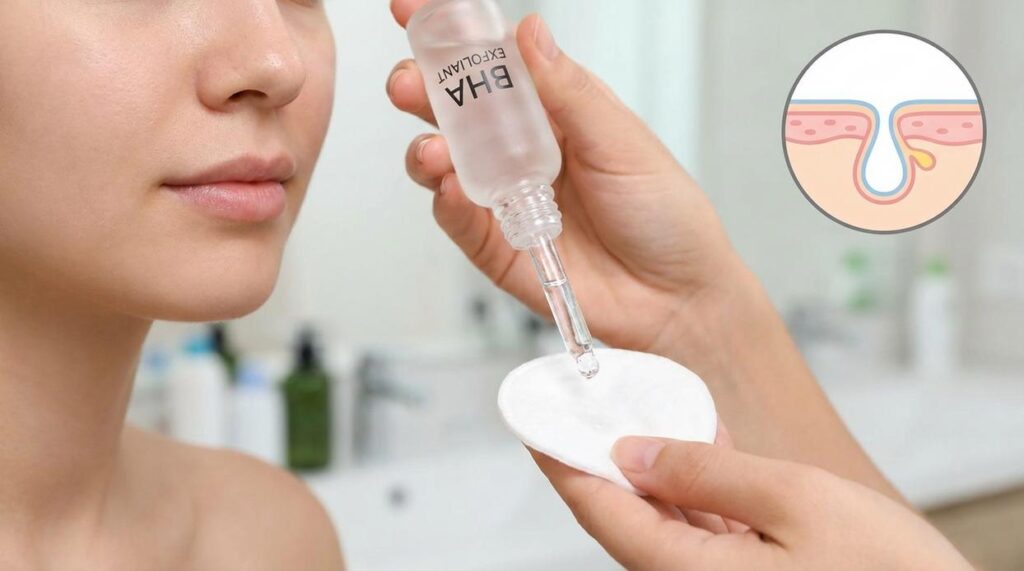
Ever notice how clogged pores feel slightly rough, almost like tiny grains beneath your fingertips? That’s where Beta-Hydroxy Acids (BHAs) step in. Unlike water-soluble exfoliants, BHAs are oil-soluble, meaning they slip through sebum (your skin’s natural oil) and travel deep into the pore lining. There, they dissolve built-up debris, loosen blackheads, and help calm the look of inflamed breakouts.
Most importantly, BHAs don’t just exfoliate the surface—they work inside the pore. This is why they’re especially effective for:
- Acne and recurring breakouts
- Blackheads and whiteheads
- Enlarged, congested-looking pores
The standout ingredient here is Salicylic Acid, the gold-standard BHA. Derived from willow bark, it’s known for its anti-inflammatory and antibacterial properties (which explains that subtle, clean scent many acne treatments have). Studies show salicylic acid reduces acne lesions by exfoliating and decreasing inflammation (American Academy of Dermatology).
Of course, some argue physical scrubs feel more satisfying—the gritty texture, the instant smoothness. However, that “polished” feeling can mask irritation. In contrast, BHAs work quietly beneath the surface.
If you’ve ever compared aha bha pha differences, you’ll find BHAs are the top choice for oily, combination, and acne-prone skin.
Additionally, consistent BHA use may improve uneven tone linked to breakouts—learn more about what causes hyperpigmentation and how skincare addresses it: https://nitkafacts.com/what-causes-hyperpigmentation-and-how-skincare-addresses-it/.
The Gentle Giant: Poly-Hydroxy Acids (PHAs)
I still remember the first time I tried a strong exfoliating acid. My skin tingled… then burned (not exactly the glow-up I imagined). That’s when I discovered PHAs—the gentler cousins of AHAs. Unlike Alpha Hydroxy Acids, Poly-Hydroxy Acids have a larger molecular size, meaning they penetrate the skin more slowly and cause less irritation. In other words, they exfoliate without picking a fight.
Like AHAs, PHAs improve surface texture and uneven tone. However, they also act as humectants—ingredients that attract and hold water—so skin feels hydrated, not stripped. Some, like Gluconolactone and Lactobionic Acid, even provide antioxidant support, helping defend against environmental stressors (think city smog and late nights).
When comparing aha bha pha differences, PHAs stand out for sensitivity.
They’re ideal for sensitive skin, rosacea, eczema, or anyone new to chemical exfoliants. If acids have scared you before, this is your soft entry point.
How to Choose the Right Acid for Your Skincare Goals
Acids sound scary, but in skincare they simply mean chemical exfoliants—ingredients that dissolve dead skin cells instead of scrubbing them off.
- For Anti-Aging & Brightening: AHAs (alpha hydroxy acids) work on the skin’s surface. They help fade dark spots and smooth fine lines—think of them as a glow booster.
- For Acne & Clogged Pores: BHAs (beta hydroxy acids) are oil-soluble, so they travel into pores to clear buildup.
- For Sensitive Skin & Gentle Exfoliation: PHAs act like milder AHAs, offering light exfoliation with less irritation.
Understanding aha bha pha differences prevents overuse.
You can combine them—but start slowly and alternate days.
Mastering Exfoliation for Clearer, Healthier Skin
You came here to finally understand how exfoliating acids work and how to choose the right one for your skin. Now you know the real aha bha pha differences, how each acid targets specific concerns, and how to use them safely for smoother, brighter results.
If you’ve been struggling with breakouts, dullness, sensitivity, or uneven texture, the problem often isn’t your effort — it’s using the wrong exfoliant for your skin type. Choosing correctly makes all the difference between irritation and a healthy glow.
Now it’s time to take action. Review your skin concerns, select the acid that matches your needs, and start with a gentle, consistent routine. Thousands of beauty enthusiasts trust expert-backed skincare guidance to avoid common mistakes and get visible results faster.
Don’t let confusion hold your skin back. Use what you’ve learned about aha bha pha differences, upgrade your routine today, and give your skin the clarity and confidence it deserves.