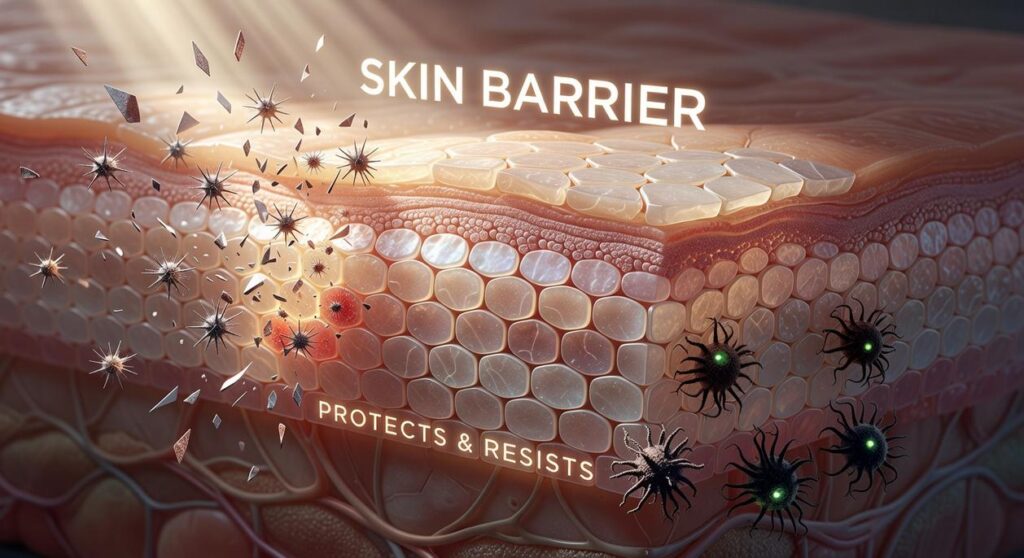
Your skin’s first line of defense does more than you think. The skin barrier function is responsible for locking in moisture, blocking irritants, and protecting against environmental stressors that can trigger dryness, sensitivity, and breakouts. When this barrier is compromised, common skin concerns quickly follow. Grounded in dermatological science and cosmetic chemistry, this guide explains how the barrier works, how to recognize signs of damage, and the exact steps you can take to restore it. If you want healthier, more resilient skin, understanding and supporting your barrier is the place to start.
Decoding the “Brick and Mortar”: What Exactly Is Your Skin Barrier?
Anatomy of the Stratum Corneum
Your skin barrier lives in the outermost layer of the epidermis, called the stratum corneum. Think of it as your body’s frontline defense system. This ultra-thin layer is responsible for preventing water loss while blocking irritants, pollutants, and microbes. When people talk about healthy glow, they’re often really talking about strong skin barrier function (even if they don’t realize it).
The “Brick and Mortar” Analogy
Dermatologists love the “brick and mortar” analogy because it just works. The “bricks” are corneocytes—flattened, tough skin cells packed with keratin. The “mortar” is a blend of lipids that seals everything together. Without mortar, a brick wall crumbles. Without lipids, your skin becomes dry, irritated, and reactive (cue the dramatic flaking).
Key Components of the Mortar
The lipid matrix is made primarily of:
- Ceramides (about 50%), cholesterol (about 25%), and free fatty acids (about 15%)
If one component drops, the entire structure weakens. Research supports this ratio as essential for barrier integrity (Feingold, 2007). Looking ahead, it’s likely we’ll see more skincare formulated to mimic these exact proportions—a return to biological balance rather than trendy actives. Pro tip: if irritation keeps recurring, your mortar—not your cleanser—may be the real issue.
The Gatekeeper’s Role: The Three Core Functions of a Healthy Skin Barrier
Your skin barrier is often compared to a brick wall—and for good reason. Think of skin cells as the bricks and lipids (natural fats) as the mortar holding everything together. When that structure is solid, your skin thrives. When it’s compromised, problems show up fast.
1. Moisture Retention
One of the most important aspects of skin barrier function is preventing Transepidermal Water Loss (TEWL)—the evaporation of water from your skin into the air. The lipid matrix seals in hydration, keeping skin plump, smooth, and resilient.
When this “mortar” weakens (often from over-exfoliation or harsh cleansers), water escapes more easily. The result? Tightness, flakiness, and fine lines that seem to appear overnight. If your skin feels dry even after moisturizing, TEWL may be the culprit.
Helpful tip: Look for ceramides, cholesterol, and fatty acids in your moisturizer—they mimic your skin’s natural lipids and reinforce the barrier.
2. Defense Against External Aggressors
A strong barrier acts like a shield against pollution, UV radiation, allergens, and harmful bacteria. Without this defense, irritants penetrate more easily, triggering redness, breakouts, or inflammation. (Ever notice how your skin freaks out after a beach day without sunscreen?)
Daily SPF and gentle cleansing are practical ways to reduce this external stress.
3. Regulating Essential Processes
Your barrier also maintains a slightly acidic pH—known as the acid mantle. This acidity supports a balanced microbiome (the community of beneficial microbes on your skin) and activates enzymes responsible for natural exfoliation.
Disrupt the pH, and skin may become dull, sensitive, or breakout-prone. A low-pH cleanser can help keep things in balance.
Signs of a Compromised Barrier: Is Your Skin Sending an SOS?

Your skin barrier is like your apartment’s security system—when it’s working, you don’t notice it. When it’s not, everything goes sideways (usually at the worst possible time). At its core, skin barrier function refers to your outermost layer’s ability to keep moisture in and irritants out.
So how do you know it’s compromised? Watch for these tell-tale signs:
- Chronic dryness or tightness, even after moisturizing
- Increased sensitivity and redness, especially around the cheeks and nose
- Stinging or burning when applying products you used to tolerate
- Persistent flakiness or rough texture that won’t smooth out
- Sudden flare-ups of acne, eczema, or rosacea
In colder climates like the Northeast during winter—or in urban areas with heavy pollution—these symptoms tend to spike. Hard water, common in many U.S. cities, can also weaken your barrier over time.
However, it’s not just the environment. Over-exfoliation (see exfoliation explained ahas bhas and phas compared), harsh foaming cleansers, unprotected sun exposure, and environmental stress are major culprits. While some argue that “more active ingredients = better results,” dermatological research shows overuse of acids can disrupt barrier integrity (American Academy of Dermatology).
If your skin suddenly reacts to everything, it’s not being dramatic. It’s asking for backup.
The Rebuilding Blueprint: 5 Essential Steps to Repair and Protect Your Barrier
Rebuilding compromised skin isn’t about adding more—it’s about doing less, strategically. If you’re dealing with tightness during New York winters or post-peel sensitivity after a med-spa visit, this blueprint applies.
Step 1 – Simplify Your Routine
First, go “skinimalist.” That means pausing retinoids, exfoliating acids, and high-percentage vitamin C. Potent actives can weaken your skin barrier function when it’s already stressed. (Yes, even the expensive serum.) Give your skin two to four weeks to reset.
Step 2 – Cleanse Gently
Next, switch to a hydrating, pH-balanced, sulfate-free cleanser. Your face shouldn’t feel squeaky—dermatologists call that “stripped.” In climates with hard water, like parts of California and Texas, this step is even more critical.
Step 3 – Focus on Barrier-Supporting Ingredients
Look for ceramides, niacinamide, hyaluronic acid, cholesterol, and fatty acids like linoleic acid. These lipids mirror what naturally exists in healthy skin.
Step 4 – Moisturize and Seal
Apply moisturizer twice daily. At night, layer an occlusive like petrolatum or shea butter to prevent transepidermal water loss.
Step 5 – Prioritize Sun Protection
Finally, use broad-spectrum SPF 30+ daily. UV radiation quietly erodes your barrier—even on cloudy days (Ferris Bueller was wrong about skipping responsibly).
From Compromised to Calm: Your Path to Resilient Skin
You came here to understand why your skin keeps reacting—and now you know the skin barrier function is the true foundation of hydration and protection. When it’s compromised, irritation, dryness, and breakouts follow. The good news? Gentle, supportive care restores balance. Start repairing your barrier today and enjoy calm, consistently healthy skin.